


Last week, a boy in our FS1 class spent nearly forty minutes moving gravel from one side of the outdoor area to the other using a small digger. He was completely absorbed. Narrating to himself, adjusting his technique, starting again when the load spilled. At no point did he look up to check if anyone was watching.
What was he learning? More than you might think. Spatial reasoning. Cause and effect. Persistence. The self-regulation to stay with something difficult. And he was learning it on his own terms, at his own pace, because it was his idea.
That moment, for me, is a near-perfect example of what play-based learning actually looks like. It is also why it is much harder to dismiss than people assume.
So what is play-based learning?
Play-based learning is an approach to early years education where children’s play, their natural and self-directed exploration of the world, is treated as the main vehicle for learning, not something that happens between lessons.
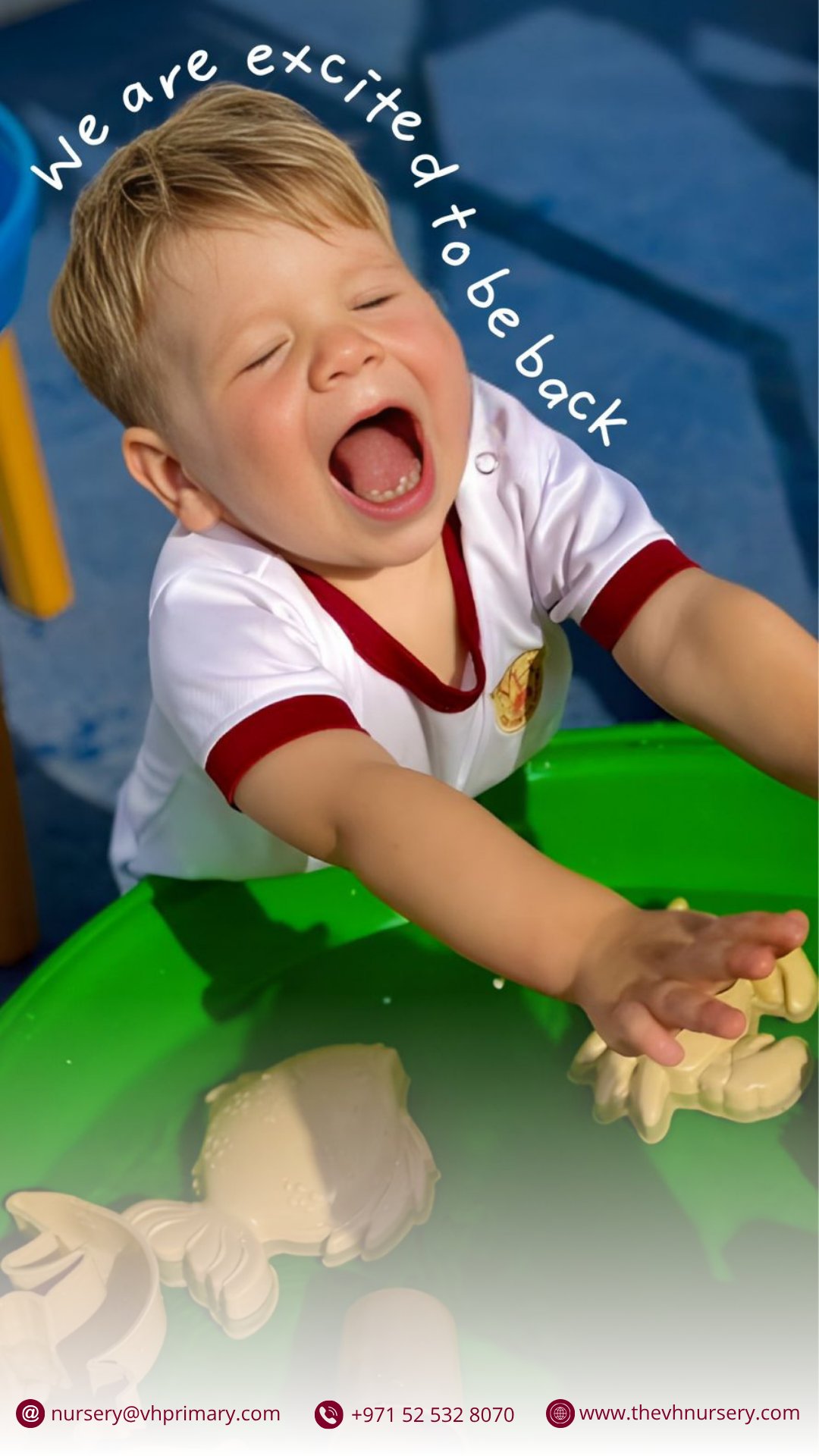
In practice at Victory Heights, this means children have extended periods each morning to move freely between indoor and outdoor spaces, following their own curiosity. There is no bell signalling the end of painting and the start of maths. The environment itself becomes the curriculum, carefully set up by teachers to invite investigation, conversation, problem-solving and imagination.
What it does not mean is that teachers sit back and watch. The adult role in play-based provision is active and highly skilled. You are observing constantly, spotting the right moment to step in and stretch thinking, and making dozens of small decisions every hour about when to speak and when to hold back.
The question I get asked most often
“But are they actually learning anything?”
After fifteen years in early years education, including leading EYFS at two KHDA Outstanding schools in Dubai, I have heard this question more times than I can count. And I understand it. When you drop your child off and see them at the water tray or the sand pit, it does not always look like the education you remember.
The honest answer is that they are learning things that are very difficult to teach any other way. Language. Social negotiation. Resilience. The ability to concentrate on something that is genuinely hard. These are not extras on the edge of the curriculum. They are the foundations everything else is built on.
The research behind this is not new or controversial. What changes is whether schools hold their nerve when parents feel anxious, when inspectors are watching, and when the temptation is to make learning look more like learning by putting it on a worksheet.
The foundations children build through play are the ones that hold when everything gets harder in Year 1, Year 2 and beyond.
Why I put the child’s interests at the centre
This is where I might lose a few people in early years.
Many EYFS settings organise provision around topics or themes. Dinosaurs this half term, transport the next. It is a perfectly reasonable approach, and I have used it myself. But my preference, and the approach we take at Victory Heights, is to plan around the interests of the children in front of us rather than a set topic.
The difference matters. When a child is genuinely interested in something, the teacher’s role shifts. You build experiences, vocabulary and challenge around what they already care about. A child obsessed with superheroes gets stories, role play, mark-making and problem-solving, all rooted in something that already has their attention.
Topic-led planning is easier to organise. It is easier to present on a planning document and easier to explain to parents. But it relies on children being interested in what we have decided they should be interested in that half term. That is not always the case.
But there is a limit to that
I believe in child-led provision. I also know it has its limits.
Earlier this year, we ran Space Week at Victory Heights. Every classroom transformed. The storytelling was immersive, the environment changed overnight, and for five days the whole school stepped into a shared narrative about exploration and discovery. The children were captivated, including those who would never have chosen space on their own.
That is the point.
Play-based learning allows children to go deep into what they already love. But children cannot be curious about things they have never encountered. Part of a teacher’s job is knowing when to introduce something new, and doing it in a way that sparks interest rather than feels forced.
Space Week worked because it was not superficial. It was immersive and carefully thought through, so children stepped into it willingly. It was adult-led, but it did not feel imposed. That balance matters.
The best early years provision does both. It follows the child, and it knows when to lead.
What this looks like day to day
When you drop your child off at 7:30am and watch them head into the classroom, here is what is happening behind what looks like play.
The environment has been prepared deliberately. Resources chosen, areas set up, outdoor spaces ready, all based on what teachers noticed the day before. A child interested in building will find new materials waiting. A conversation from yesterday might reappear in the writing area.
Teachers are moving, watching, and asking questions that open thinking rather than shut it down. The child at the gravel pile is not being ignored. He is being given space to concentrate, which is one of the most valuable things a school can offer a four-year-old.
The school day finishes at 1:15pm. In that time, a child in FS1 will have talked, built, investigated, negotiated, created, eaten independently, and moved between indoor and outdoor spaces. On some days, they will also have swimming or music with a specialist teacher.
It is a full morning of learning.
It just does not look like the version most of us grew up with.